
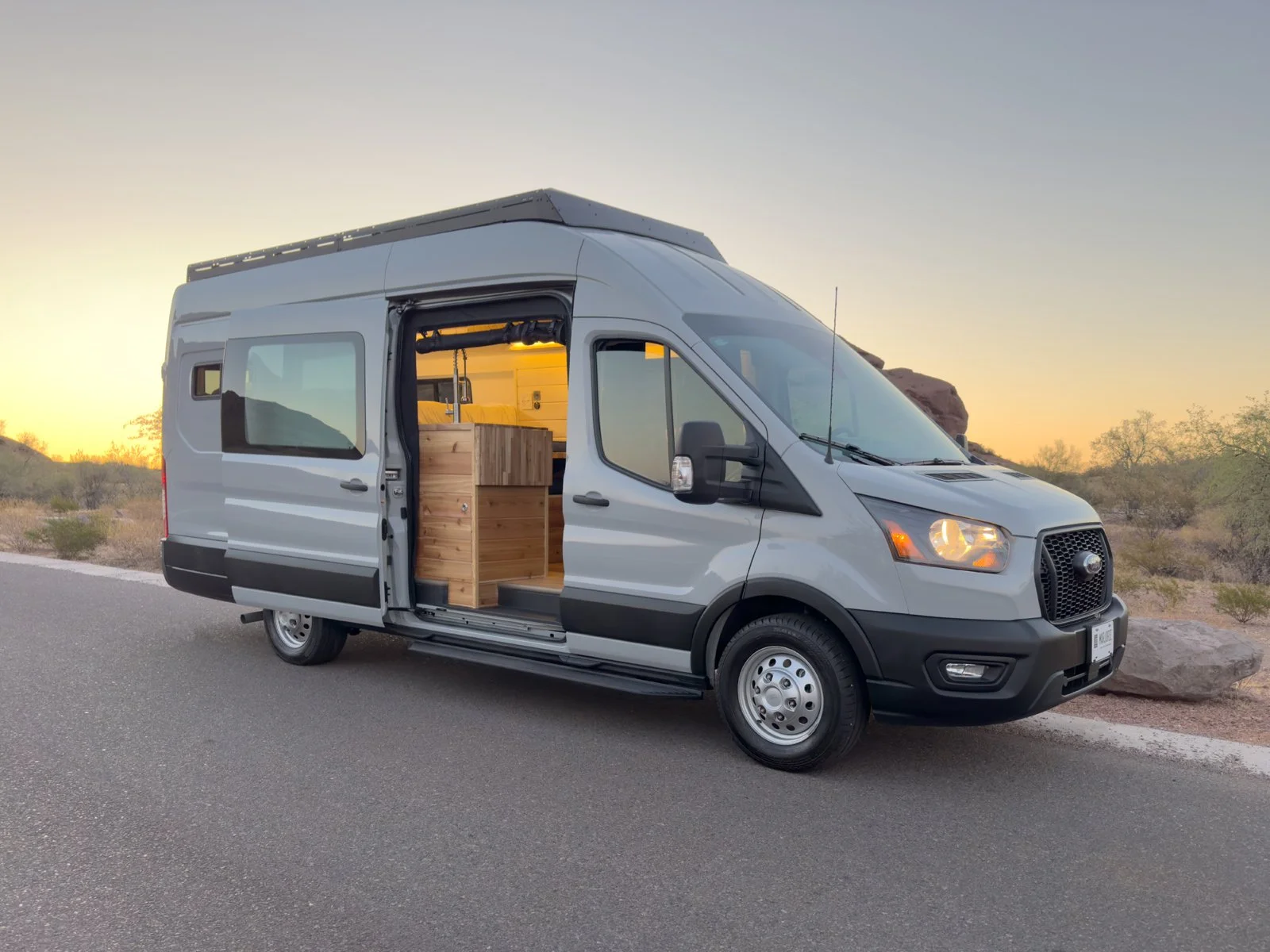
Choosing a camper van chassis is one of the first big decisions in any build, and it shapes everything that follows: how your layout fits, how the van drives, what it costs to own, and whether you can find a service center when you’re two hours from the nearest town. The Mercedes-Benz Sprinter, Ford Transit, and Ram ProMaster are the three platforms you’ll hear about most in the North American conversion world, and for good reason.
At Boho Camper Vans, we build custom conversions on all three chassis: Sprinter, Transit, and ProMaster. That build capability doesn’t always match day-to-day inventory, though. Our rental fleet and used-van listings shift over time and have leaned heavily toward ProMaster conversions, so check our current used van inventory or rental fleet before assuming a specific chassis is available to rent or buy right now. This guide breaks down what each chassis offers so you can choose what fits your travel plans, not just your wish list.
What Is a Camper Van Chassis?
The chassis is the base vehicle before any conversion work begins: the cab, drivetrain, body shell, and factory systems a builder works around.
For a camper conversion, it determines interior geometry, payload limits, drivetrain options, and long-term serviceability. Two builds with identical layouts can feel completely different depending on the chassis they sit on.
Sprinter vs. Transit vs. ProMaster: Quick Comparison
All three platforms are capable camper van bases. The right one depends on your layout, budget, drivetrain preference, and travel plans.
The figures below reflect 2025 model-year, manufacturer-published specifications for a representative configuration of each van, not Boho’s finished interior measurements after insulation and paneling. Finished interior space always runs smaller than raw cargo specs.
| Feature | Mercedes-Benz Sprinter | Ford Transit | Ram ProMaster |
| Engine | 2.0L I-4 diesel (168/208 hp) | 3.5L PFDI V6 (275 hp) or 3.5L EcoBoost V6 (310 hp) gasoline | 3.6L V6 gas, 276hp |
| Drivetrain | RWD standard; AWD optional | RWD standard; AWD optional | FWD only |
| Interior standing height (Cargo, High Roof)* | 79 in | 81.5 in | 77 in |
| Interior width at wheelhouses | ~53 in (pending verification) | 54.8 in (SRW) / 45.4 in (DRW) | 56 in (between wheel wells) |
| GVWR (example config) | Pending (2500-specific figure not yet confirmed) | 9,070–9,150 lbs (T-250) | 8,550 to 9,350 lbs (pending verification) |
| Starting MSRP (2025)** | Pending confirmation | Pending confirmation | ~$47,055 (confirmed) |
| Principal advantage | Diesel efficiency; AWD option | Balance of driveability and service access | Widest interior; lowest floor |
| Main compromise | Higher service costs; narrower interior | No diesel option | FWD only; single engine choice |
| Best for | Four-season and long-haul builds | First-time converters; all-around builds | Space-focused and budget-conscious builds |
*Starting MSRP figures are approximate, pre-destination-charge list prices; trim levels and standard equipment are not identical across platforms. Confirm current, comparably equipped pricing with each manufacturer before use.
Specifications vary by model year, wheelbase, roof height, and configuration. Confirm current figures with your builder, dealer, or primary manufacturer sources (Ford, Stellantis, and Mercedes-Benz commercial van specification pages) before purchasing.
Interior Space and Camper Conversion Fit
Cargo volume figures don't tell the full story. For a camper build, what matters is usable geometry: floor width after insulation, whether you can sleep lengthwise, and how much headroom remains once wall panels go in.
Cargo Width and Bed Layout
ProMaster: 56 in between the wheel wells, with a 75 in maximum cargo width and a flat floor with minimal wheel well intrusion. This makes it the easiest platform for a crosswise bed or straight cabinetry runs.
Transit: 54.8 in between the wheelhouses on single-rear-wheel (SRW) configurations, narrowing to 45.4 in on dual-rear-wheel (DRW) configurations, per Ford’s own 2025 specifications. Wall curves grow more pronounced toward the top, so usable width tightens further after insulation.
Sprinter: Narrower at the wheelhouses, commonly cited around 53 in, though Mercedes-Benz’s published specs only confirm an overall maximum cargo floor width of 74 in, not the narrower wheelhouse measurement. This figure still needs a matching source before publishing.
Note: width at bed height is a separate measurement from width at the wheelhouses, and the two shouldn’t be used interchangeably when comparing platforms.
Roof Height and Van Length
| Sprinter | Transit | ProMaster | |
| Standing height, High Roof | 79 in (Cargo) | 81.5 in (Long, High) | 77 in |
| Standing height, tallest available roof | 79 in (no taller roof offered on Cargo) | 81.5 in (same as high, no extended-height option) | 86 in (Super High Roof) |
| Wheelbase options | 144 in / 170 in | 130 in / 148 in | 118 in / 136 in / 159 in |
| Roof options | Standard, High | Low, Medium, High | Standard, High, Super High |
The ProMaster’s Super High roof offers more standing room than any High Roof option on the other two platforms, but that comparison only holds at the Super High tier — its own High Roof trim (77 in) sits closest to Sprinter’s 79 in. Compare heights only within matched roof tiers, and verify Sprinter’s wheelhouse width and exact GVWR/payload figures against Mercedes-Benz’s detailed tech specs document before publishing.
Payload and Build Weight
A completed camper build typically adds 1,500 to 2,500 lbs or more over an empty van, so brochure-listed maximum payload figures don’t reflect what’s left once a conversion is finished.
Per Ford’s 2025 specifications, Transit payload ranges from about 3,450 to 4,095 lbs on T-250 configurations (GVWR 9,070–9,150 lbs), and 3,619 to 4,445 lbs on T-350 configurations (GVWR 9,500 lbs), depending on wheelbase, roof height, engine, and drivetrain.
Sprinter and ProMaster payload figures specific to the 2500-class vans Boho typically converts are still unconfirmed — Mercedes-Benz’s brochure only lists the heavier-duty 4500 chassis cab’s maximum (6,812 lbs), and Ram’s design page doesn’t include payload data at all. Both need their dedicated tech-specs documents before publishing exact numbers.
These are manufacturer maximums for an empty chassis, not the payload remaining after a finished conversion. Always check the door-jamb payload label and front and rear axle weight ratings (GAWR) on your specific van, and weigh the completed, loaded vehicle on a certified scale before adding passengers or gear.
Driving Performance and All-Weather Capability
| Sprinter | Transit | ProMaster | |
| Drivetrain | RWD / AWD optional | RWD / AWD optional | FWD only |
| Engine | 2.0L diesel; strong low-end torque | 3.5L V6 gas; smooth highway feel | 3.6L V6 gas, 276hp; adequate under load |
| Winter capability | AWD available; follow diesel cold-weather operating guidance | AWD available; flex-fuel option | FWD manages light snow; may be less suitable for steep mountain passes or deep-snow routes, particularly without appropriate tires, chains, and route planning |
| Towing capacity | Up to 5,000 lbs on many 2,500 configurations; up to 7,500 lbs in applicable higher-capacity configurations | Varies substantially by configuration; confirm the Ford specification sheet for the exact van | Up to 6,910 lbs (config-dependent) |
| Driveability | Tall and narrow; takes adjustment | Most car-like of the 3 | Wide and easy to place on the road |
AWD improves traction but doesn't replace appropriate tires, route planning, or driver judgment on serious winter or mountain routes.
Purchase Price and Long-Term Ownership Costs
Upfront Price and Supply
Starting MSRPs vary by platform, but you can’t directly compare published figures until you match trim level, cab configuration, and standard equipment across manufacturers. As of the figures Boho last confirmed, approximate starting points fell somewhere between $47,000 and $51,000 depending on platform, before destination charges, taxes, and dealer fees.
Treat any single starting price as a reference point rather than a ranking, and confirm current, comparably equipped pricing directly with each manufacturer or dealer before purchasing. The gap between platforms typically widens once options, upfitting, and configuration choices are added.
If you’re open to a pre-owned platform, Boho Camper Vans offers used van campers on all three chassis, including retired rental fleet vehicles that have already been professionally converted.
Fuel and Maintenance
The Sprinter’s diesel engine typically delivers better fuel economy on long-haul trips. Diesel maintenance intervals can be longer, but emissions system work (DEF fluid, DPF filters) costs more when it does arise. The Transit and ProMaster run on regular gasoline, which simplifies fueling across North America.
Neither gas platform is a clear maintenance cost winner; actual costs depend on mileage, load, and driving conditions. For buyers who want to spread the cost of a build over time, camper van financing is available, with terms and approval subject to lender qualification.
If you’re ready to talk through which chassis and financing path fits your build, start a build consultation with the Boho team as your next step.
Service and Parts Access
Transit: Ford's dealer and service network is extensive across the US, which can make routine service and parts access easier in many areas
ProMaster: Ram/Stellantis dealers are broadly distributed; generally similar accessibility to the Transit
Sprinter: Mercedes-Benz commercial van service concentrates in larger cities. A breakdown in a rural area can mean longer wait times and higher transport costs
For travelers covering serious ground, service access can matter more than small spec differences between platforms.
Advantages and Trade-Offs of Each Van
Mercedes-Benz Sprinter
Considerations: diesel power, available AWD, configuration choices, and qualified service access.
Diesel engine delivers strong torque and efficiency on long hauls
AWD is available for travelers who want additional traction; compare the specific configuration, tires, and operating conditions
Large aftermarket conversion ecosystem with extensive builder experience
Higher entry price, narrower interior, and more limited service network than the other 2
Ford Transit
Considerations: gasoline power, available AWD, service access, and a range of configurations.
Most car-like driving feel of the 3; the easiest adjustment for new van owners
Ford's dealer and service network is extensive across the US
Wide range of roof heights, wheelbases, and body lengths
No diesel option; payload varies by configuration and should be confirmed for the specific vehicle
When comparing a transit conversion with other platforms, evaluate the exact configuration, finished layout, and availability of qualified service along your routes.
Ram ProMaster
Considerations: interior width, available roof heights, front-wheel drive, and a low load floor.
Widest, flattest floor of the 3; easiest platform for straight cabinetry and crosswise sleeping
The super high roof option offers the most standing room in this class
FWD layout lowers the floor and simplifies the drivetrain but may be less suitable for travelers who regularly drive steep mountain passes or deep-snow routes
Single engine choice (3.6L V6, 276 hp) offers less flexibility than the other two platforms
Best Camper Van Chassis by Use Case
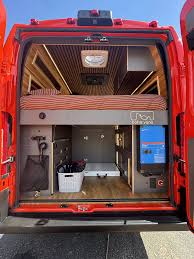
Full-Time and Family Builds
Prioritize payload headroom, floor plan geometry, and service access. The Sprinter and ProMaster both offer strong payloads in comparable configurations. The ProMaster's wider floor makes full-time layouts easier to build; the Sprinter's AWD and diesel suit high-mileage full-timers in varied climates.
Confirm legal belted seating for your group before finalizing any platform.
Winter and Mountain Travel
AWD is available on both the Sprinter and Transit. For serious mountain or four-season use, an AWD configuration of either platform, paired with appropriate tires, is the more practical choice. The ProMaster's FWD layout handles light winter conditions adequately but may be less suitable for regular mountain pass driving or heavy snow regions.
Interior Space and Build Planning
The ProMaster's lower starting price, wider interior, and simpler FWD drivetrain make it a popular choice for DIY converters working within a tighter budget. The transit is a close second, with the advantage of easier parts sourcing. Buying solely on the lowest advertised price without accounting for payload, configuration, and service access can cost more in the long run.
How to Choose the Right Camper Van Chassis
Work through these before you commit:
Define your floor plan first: Know whether you need a crosswise bed, a fixed kitchen side, or a wet bath before picking a platform. Interior geometry should drive the chassis choice, not the other way around
Estimate your loaded weight: Add up insulation, cabinetry, batteries, water, appliances, gear, and passengers. Check it against the door-jamb payload label on the specific vehicle
Rank your drivetrain needs: If you need AWD or diesel, that rules out the ProMaster immediately
Check local service coverage: Where will you travel most? If it's off the beaten path, the Transit's service network is hard to beat
Set a complete budget: Include the chassis, the conversion, fuel type, insurance, and expected maintenance, not just the sticker price
For a hands-on look at how each platform performs across different routes and conditions, start with Boho's camping trip ideas.
The Right Van Is the One That Fits How You Travel
There's no single winner here, and anyone who tells you otherwise is probably selling you one specific platform. The Sprinter earns its reputation: diesel efficiency and AWD in one package is genuinely hard to beat for serious four-season travelers.
The Transit offers gasoline engine choices, optional AWD, and a broad service network; evaluate how the specific vehicle fits your priorities. The ProMaster gives you more interior room per dollar than either of the other two, which matters more than people realize once you add a full build.
At Boho Camper Vans, we'll help you figure out which platform actually suits your build. If you want to experience van life before committing, you can rent a camper van from our fleet first, try a few routes, and come back with a much clearer sense of what you actually need.
FAQs
-
There's no universal answer. The best chassis depends on your floor plan, loaded weight, climate, service access, and budget. All 3 platforms have produced excellent builds; the right fit depends on your priorities.
-
Reliability varies by model year, powertrain, mileage, maintenance history, and conversion weight. The most reliable van is generally the one that's been well maintained and not overloaded, regardless of brand.
-
The ProMaster leads in floor width and, with its super-high roof, in standing height. The Transit and Sprinter offer more length options. For a camper build, usable width, standing height, and wall geometry matter more than total cargo volume.
-
Not for most travelers. Quality all-season or winter tires and smart route planning handle most conditions a camper van encounters. AWD adds meaningful capability for serious mountain or winter use and is available on both the Sprinter and Transit.